
Settler Violence = State Violence
Security forces fail to protect Palestinians from settler attacks in incidents documented by B’Tselem over last three months
29 May 2013, updated 28 October 2013
Update: On 15 September 2013, B'Tselem received a reply from the Military Advocate for Operational Affairs indicating that a criminal investigation had been opened into the incidents at Yasuf and 'Urif. The reply also stated that "military officials" had been approached for their opinion regarding the other incidents.
On 30 September 2013, B'Tselem received a reply from Central Command’s Department of Public Inquiries stating that the incidents are being examined by the Military Police Investigation Unit (MPIU) and by the Military Advocate for Operational Matters. The letter further stated that "Central Command condemns any violent conduct toward residents of the area or their property and, in conjunction with other security authorities, takes great pains to put an end to such incidents".
In recent months, B’Tselem staff and volunteers have captured on video several incidents in which settlers attacked Palestinians or damaged their property in the presence of security forces. Most of the incidents described here occurred following the stabbing to death of Yitzhar resident Evyatar Borovsky at Tapuach junction, on 30 April 2013. The other two incidents occurred at other times and in different areas in the West Bank.
Description of incidents:
Settler attack in Yasuf
On 16 March 2013, a B’Tselem volunteer in the village of Yasuf documented settlers throwing stones at Palestinians. In the video footage he filmed, soldiers are seen standing next to the settlers while the latter continue to throw stones unhampered. Throughout the footage, the soldiers are not seen taking any action to stop the settlers from throwing stones or to arrest them.
Settler attacks after Tapuach junction attack
2. On 30 April 2013, after the attack in which Yitzhar resident Evyatar Borovsky was stabbed to death, dozens of settlers attacked Palestinians in nearby villages and on main roads in the area. Among other things, they threw stones at Palestinians and at Palestinian vehicles. In addition, settlers are suspected of having started fires at several places in the area that day. B’Tselem volunteers captured video footage of violent incidents that occurred in three places that day, and a B’Tselem field researcher gathered written testimonies regarding an additional incident:
- ‘Urif– a B’Tselem volunteer documented masked settlers throwing stones at the village school, which was empty as the staff had evacuated all the students for fear of settler attacks. The footage shows soldiers standing by settlers as the latter throw stones at Palestinians, who are approaching the school and throwing stones at the settlers. The soldiers’ body language indicates that, at most, they asked the settlers to stop throwing the stones, but did not take any firm action to stop the attack. The footage shows no attempt made by the soldiers to identify or detain the settlers. At a later stage, the soldiers are even seen shooting teargas grenades at the Palestinians who arrived at the scene. At a certain point, a group of some twenty settlers is seen freely entering the village and shattering the windows of a mosque.
- Burin – a group of some twenty masked settlers threw stones at the home of the Sufan family, which lies on a hillside at the outskirts of the village. The settlement of Yitzhar is on the hilltop above. In footage filmed from within the house by a family member who volunteers with B’Tselem, the settlers are seen approaching the house while trying, apparently, to set fire to fields along the way. Then, for several minutes, the settlers are seen throwing stones at the house undisturbed. They are seen drawing back only after a force of soldiers and Border Policemen arrives at the scene. The soldiers are seen following the retreating settlers, but do not detain any of them nor attempt to identify them. As the Sufan home is regularly attacked by settlers, the security forces should have anticipated an attack following the stabbing at Tapuach junction and should have deployed to prevent it. Thus, although the forces did remove the settlers from the spot eventually, the entire incident could have been prevented in advance.
- ‘Asira a-Qibliyeh – in footage filmed by a B’Tselem volunteer, a group of masked settlers is seen approaching the outskirts of the village while throwing stones. Some security personnel are seen apparently intervening and trying to stop them, but the settlers ignore them and continue throwing stones. Even when the settlers are finally pushed back by the security forces, they continue to throw stones as they withdraw, while the soldiers are not seen arresting or detaining any of them. Smoke rising from fields nearby raises the suspicion that the settlers also torched them while security forces were present.
Attack on bus near Yitzhar junction
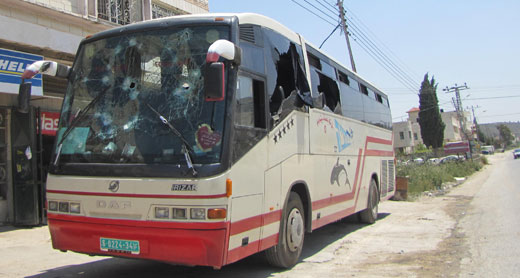
One of the buses attacked by settlers. Photo: Salma a-Deb'i, B'Tselem, 30 Apr. 2013
B’Tselem field researcher Iyad Hadad collected written testimonies concerning another incident, in which settlers threw stones at two buses carrying Palestinian schoolgirls as they drove by the Yitzhar junction. According to a testimony given by one of the bus drivers, the road was blocked by a military vehicle, apparently because the military had anticipated that settlers would attack Palestinian vehicles driving any further along the road. The drivers had no choice but to stop at the junction, where some seventy settlers had gathered. The settlers began throwing stones at the buses in plain sight of the security forces, who did nothing to prevent the attack or to arrest the stone-throwers. One of the bus drivers and two schoolgirls were lightly injured, and many of the schoolgirls suffered anxiety symptoms.
Settler attack at Deir Jarir
On 3 May 2013, B’Tselem’s spokesperson Sarit Michaeli witnessed an incident in which masked settlers attacked Palestinians who were protesting the establishment of an outpost called Netzach Binyamin close to the village of Deir Jarir. During the incident, a group of eleven settlers came from the direction of the Amona outpost and approached the protesting Palestinians, while soldiers at the scene did nothing to stop them. The soldiers fired teargas at the settlers only after the settlers and the Palestinians began throwing stones at each other, an escalation that could have been prevented, protecting both sides from danger. Eventually, the soldiers forced the settlers to go back towards Amona, and policemen who arrived at the scene arrested a minor who was with them.
The responsibility of the security forces
The security forces are bound, both by Israeli law and by international law, to protect Palestinians from attacks by settlers. However, B’Tselem’s documentation of the abovementioned incidents shows that the security forces repeatedly failed to fulfill this duty. Thus, they did not prepare adequately or deploy sufficient forces to prevent the anticipated attacks on Palestinians after the Tapuach junction attack; such preparation would include, for instance, blocking settlers’ access to Palestinian villages. Even in cases where settlers were clearly on their way to attack Palestinians, the security forces in the area did not act to prevent or arrest them. Forces present during the attacks themselves did nothing to stop the violence occurring before their very eyes, and did not detain violent settlers in order to bring them to justice
B’Tselem wrote to the law enforcement authorities demanding investigations of the settlers’ violence and the security forces’ conduct in these incidents. In addition, B’Tselem wrote to OC Central Command demanding that he ensure adequate preparation of the forces for future incidents of settler violence. Accordingly:
- All security forces in the West Bank must be briefed, clearly and unequivocally, that it is their duty to do all that is within their power to prevent settlers from attacking Palestinians or their property. When such violent incidents do occur, it is their duty to identify and detain the attackers until the police arrive, or to arrest them in the absence of available police forces, and to give witness accounts to the police regarding the attacks. They must also be apprised of their basic duty to protect Palestinians, who are a protected population under international law.
- The security forces must prepare in advance to prevent settler attacks that can be anticipated – for instance, after attacks by Palestinians or after the evacuation of outposts and settlements. In such cases, they must, among other things, restrict the movement of settlers who are already on their way to Palestinian communities with a clear intention to act violently.
- Security forces must be deployed regularly in well-known sites of confrontation that are susceptible to attacks by settlers. Accordingly:
- They must prepare to prevent settlers from coming close to communities that are regularly the victims of such attacks. For instance, the ongoing settler violence against the villages close to Yitzhar merits increased and regular presence of security forces in the area.
- In any case, security forces must not deal with settler violence by restricting Palestinians’ freedom of movement. The military used this measure, for instance, in the days after the Tapuach junction attack, by blocking Palestinians’ movement north on Route 60, from Huwara towards Jit. Similarly, the military placed a physical obstacle at the entrance to Deir Jarir, and removed it several days later.
Fulfilling these obligations, and especially preparing in advance to prevent anticipated attacks, indeed requires the allocation of forces and resources. However, as long as the state enables and encourages the establishment of settlements, it is the military’s duty to protect the Palestinians, who are the protected population living in occupied territory, and not only the Israeli citizens living in the settlements. The military must not accept as given a reality in which the presence of settlers regularly endangers the welfare of Palestinians.


