Open-Fire Policy
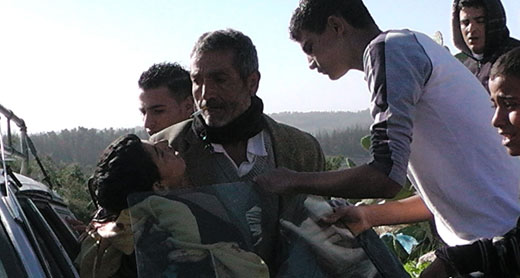
On Sunday, 7 January 2024, at around 5:00 P.M., Muhammad and Duha Abu ‘Eid, a couple from the village of Bidu in al-Quds District, arrived at the military checkpoint at the entrance to Beit Iksa. They accelerated into the checkpoint and hit a Border Police officer, lightly injuring her. Two officers who were standing next to her and were not injured opened heavy fire, killing the couple and firing more than 30 bullets at a shared taxi that was crossing the checkpoint ahead of the couple’s car. One of the bullets hit Ruqayah Jahalin, 4, who was traveling in the taxi with her family.The taxi driver continued driving until he was a few meters past the checkpoint, and then stopped. The passengers, who feared the officers would shoot them if they came out, waited in the taxi with the wounded Ruqayah. About fifteen minutes later, Ruqayah stopped breathing, and the taxi driver mustered the courage to tell the officers there was a wounded child in the taxi. The officers took the mother and daughter to a Magen David Adom ambulance that arrived at the scene, where paramedics attempted resuscitation to no avail. The mother remained in the ambulance with her daughter’s body for about an hour, at which point the officers removed the body and placed it on the ground, a few meters away from the bodies of the couple from the first car.After about half an hour, Ahmad Jahalin, Ruqayah’s father, arrived. He and his wife were kept at the checkpoint, where they were interrogated, until after midnight. They were then allowed to go home, but without their daughter’s body, which was left lying on the ground. It was not until 16 January 2024, nine days after Ruqayah was killed, that the military returned her body to her family.B’Tselem field researcher Iyad Hadad collected testimonies from the mother and from the taxi driver on 10 January 2024:‘Aishah Jahalin, 39, a mother of six, said:On Sunday, 7 January 2024, I was with my four children, Marwa, Rahmeh, Ruqayah and Muhammad, on a family visit in Beit Hanina al-Balad. At 4:50 P.M., we set out to go home to the village of Beit Iksa. We were riding in a shared Ford Transit taxi. I knew the driver. There were two women from the village, whom I don’t know, with us in the taxi. One was sitting next to the driver and the other behind him. I was sitting next to the one behind the driver, and the children were sitting next to me and behind me.We got to the checkpoint at 5:00 P.M. We were between 15 and 20 meters away from the first gate, waiting for a signal from the police. There were no cars ahead of us. After a minute or two, the gate opened and the driver advanced and stopped in front of the inspection room, in the middle of the checkpoint. There were a policewoman and two policemen there. The policewoman took ID cards from the driver, the two other women and me. She looked at us, gave us back the IDs and let the driver through. We were about 10 meters away from the second checkpoint gate, and the driver was driving slowly towards it.Suddenly, I heard a commotion and police officers shouting, and then heavy gunfire started behind us. The bullets penetrated the taxi and glass shards flew everywhere. I put my head down immediately and hid behind the driver’s seat. Everyone else did, too. I pulled Muhammad down to the floor of the taxi, in front of me. Then I turned around and pulled Ruqayah, too. That’s when I discovered she was wounded. There clothes on her back had blood on them and she was crying. I sat her in my lap and tried to calm her down. The seconds that passed until the shooting stopped felt like a year. Meanwhile, the driver kept driving, passed the gate and then veered right and stopped.I wanted to get out of the taxi to ask for help for Ruqayah, but the driver told me they’d shoot me if I went out. I sat with Ruqayah inside the taxi. She was in a lot of pain. There was a big commotion outside. A lot of forces came, of all kinds, and they all gathered near the inspection room, around a car that must have come after us. I didn’t understand what happened exactly.About 15 minutes later, Ruqayah went silent. She wasn’t moving or breathing. The driver called out to one of the police officers, and he answered something I didn’t understand. It was only then that I dared get out of the taxi with Ruqayah. One of the police officers saw me and asked what I wanted. I told him my daughter was injured. He didn’t understand what happened and how she was injured, so I told him the police officers shot her.The officer took me to a Magen David Adom ambulance that was there. I don’t know when it got there. They put me and Ruqayah in the ambulance, put her on the bed and hooked her up to oxygen. They tried to give her CPR, but it didn’t help. Then they gave her electrical shocks, but it didn’t help either. She didn’t respond. They tried for a few minutes and then the paramedic told me he was sorry, but Ruqayah was dead.They closed the ambulance door and left me in there for about an hour. No one spoke to me. I sat there, holding Ruqayah and crying. After about an hour, they took her, laid her by the side of the road and covered her. They told me to stand aside, 10 meters away from her.I asked them to call my husband. I was scared. My whole body was shaking. I didn’t know what was going to happen. After about half an hour, my husband Ahmad came. Some people questioned Ahmad and me. One said he was a police officer and another said he was from the army. I was in shock and didn’t really answer their questions, so they directed most of the questions to Ahmad. I saw two more bodies by the side of the road, covered in an aluminum blanket.About 40 minutes after Ahmad arrived, I saw the driver was back. He said he’d driven the children to our house in the village. The police checked the taxi and interrogated the driver. At 11:00 P.M., they brought a tow truck that took the taxi and the other car away. They only let us leave until midnight, but they wouldn’t let us take Ruqayah’s body with us. They still have it. They’re saying it’s in order to complete the investigation and run forensic tests [the body was returned to the family on 16 January].The taxi driver said:I work the line between Beit Iksa and nearby villages. On Sunday, 7 January 2024, at 4:45 P.M., I drove seven passengers from the Bidu roundabout to Beit Iksa: Two women, one of whom sat next to me and the other behind me, and a mother with four children. The mother sat in the middle seat in the middle row, with some of her children next to her and some in the back seat.We got to the checkpoint at 5:00 P.M., and I followed the instructions. I stopped in front of the “stop” sign and after less than a minute, the police officers opened the gate and one of them signaled for me to advance. There were two policemen and a policewoman there. I advanced until the taxi was next to the guards’ room. The policewoman asked for the ID cards of the people in the taxi. She checked them and then gave them back to us and opened the gate for us. I drove on slowly.I drove towards the second gate, which had already been opened. When I was about five meters away from it, and ten meters from the police officers, shots were fired at us from behind. There was panic and shouting in the taxi. I put my head down and hit the gas pedal to get away from there. Bullets shattered the rear window and entered the car. I drove about ten meters without seeing anything in front of me. After I went through the second gate, the engine went off. I must have taken my foot off the clutch in confusion.The shooting stopped after less than a minute, but even then, I was still in shock and didn’t even know if I’d been hit. I asked everyone to check themselves and the passengers said they weren’t hurt, except for one girl who I later found out was named Ruqayah. I called the Bidu village ambulance and told them a little girl was injured in a taxi at the checkpoint. The ambulance from Bidu arrived within five minutes. It stopped far from the checkpoint and turned on the siren, but they didn’t let it in. Then police cars arrived, followed by more soldiers and police officers.After about 15 minutes or so, Magen David Adom ambulances arrived, I don’t know how many. It was only then that I dared stick my head out of the window, and I called out to the police in Hebrew that I had an injured child with me. The police officer immediately called the paramedics and the mother got out with her girl and went towards the area of the checkpoint. They opened the gate for her and took her with the girl to one of the ambulances. Her other children stayed with me.I asked one of the officers if I could leave, because I had little children with me, and he told me to wait. After five minutes, another police officer arrived and ordered me to leave. I drove towards Beit Iksa, about 200 meters past the checkpoint, where I met the children’s relatives and they took them. I drove on to the village, dropped off the other two passengers and went home.At 6:20 P.M., “Captain Fares” called me and said I had to come back to the checkpoint with the taxi. I went back there and stood in the right lane. There were a military investigator and police investigators there. They searched me and asked me some questions about what happened. They took photos of the taxi.I saw two bodies lying on the road, wrapped in aluminum foil. I later found out they were a couple. The girl’s body was five meters away from them. She was covered in white gauze. The mother and her husband were standing 20 meters away from me, surrounded by investigators who were probably questioning them.The investigators and I counted more than thirty bullet marks on the taxi, most of them on the right side. Some of them went through the back seat. At 7:00 P.M., they put my taxi on a tow truck and took it away from there. I was put in a military vehicle and taken to Ofer prison.I waited there for about half an hour, and then they searched me and put me in a room with someone who introduced himself as “Abu Rami.” He showed me videos from a security camera. I couldn’t see anything clearly. They took down my information and contact details. The interrogation was over after about 20 minutes and then I waited for them to take me back to the checkpoint. At about 11:00 P.M., they dropped me off there. The bodies were still there.I crossed the checkpoint on foot and my brother picked me up on the other side and drove me home.
18 April 2024