
Unlawful detention for questioning of boy under age of criminal responsibility, al-'Esawiyah, 12 October 2012
4 December 2012
According to testimonies collected by B’Tselem, plainclothes police detained Amir Darwish, at midday on Friday, 12 October 2012, two days before his tenth birthday. The policemen took Amir to a police station, using force against the boy and his mother, who tried to prevent the arrest. Amir was questioned in his mother’s presence for allegedly throwing stones, and was released following the investigation.
The minimum age of criminal responsibility in Israel is 12. The arrest or even temporary detention of a minor under the age of 12 is absolutely prohibited.
Around midday on Friday, 12 October 2012, while Amir Darwish was in the yard of his home with his 12-year-old cousin, a group of undercover police arrived, accompanied by a uniformed police escort. The police, who claimed that Amir had thrown stones at the nearby Hadassah Mt. Scopus Hospital parking lot, detained him for questioning.
In her testimony to B’Tselem, Amir’s mother, Jihad Darwish, related that when the police arrived to arrest her son, both she and her husband were home, but her husband was asleep. Following is her description of the incident:
“I heard people talking outside the house. I went out to the yard and saw three people in civilian clothes talking with Amir and his cousin. Amir was sitting on a couch in the yard. The people spoke Hebrew and I didn’t understand what they were saying. Suddenly, one of them grabbed Amir by the arm and pulled him off the couch toward the main road. Amir began shouting: “Mom, Mom.” I walked away from the house, went up to him and hugged him. I tried to prevent the man from taking him. At the same time, I heard a voice coming from a two-way radio that one of the three men had. It was then that I realized they were apparently undercover police. A few seconds later, I saw four armed, black-uniformed policemen, coming in our direction. They pushed me and I fell down. Amir fell with me but I kept on hugging him. One of the undercover policemen grabbed Amir and pulled him hard. Amir shouted, “Mom, Mom.” I grabbed his shirt, and the police who were trying to pull Amir dragged me along the ground. My left leg got scraped and I was in pain. I was panicky and felt that I was choking, and I let go of Amir. The police kept going with him.
[block:views=see_more_videos-block_1]
At that point my sister-in-law, 'Aliaa, arrived and tried to get the police away from me. One of them struck her in the chest with his rifle. I heard Amir crying. He screamed and called for my help. But a short time later, the police left, taking Amir with them, and I couldn’t see him anymore.”


In his testimony to B’Tselem, Amir Darwish recounted the following: “One of the undercover policemen punched me in the head. It hurt. The undercover police put me in a jeep. One of them asked me: ‘How old are you?’ I told him that I was nine years old. The undercover police didn't hit me on the way, but I was afraid because I was alone. They took me out of the jeep at the police station. There was a policeman there who told me: ‘Sit here and don’t move, otherwise I'll slap you.’ I was very scared.”
In her testimony, Amir’s mother related that she went back inside and woke her husband, who had been asleep and had not heard what was going on outside. The parents went together to the Shalem police station on Salah a-Din Street, where they thought their son had probably been taken. When they arrived at the station, they found that Amir had indeed been brought there. Amir's father voiced his objections to the violent detention of his son, and exchanged strong words with a policeman. Consequently, the policeman told him to leave the station.
Both parents left the station. About half an hour later, Amir’s mother returned in the company of Darwish Darwish, the mukhtar of al-'Esawiyah, and a relative. In her testimony, she described what happened next:
“When I went in to the police station with the mukhtar, I saw my son standing among several border policemen. I saw the fear on his face. His pants were wet. I realized that he had wet his pants from fear. I tried to talk with him and reassure him, but the border policemen standing next to him wouldn't let me to talk to him.”
After waiting for about half an hour, Amir was taken into an investigation room together with his mother. A plainclothes investigator questioned him about the incident that preceded his detention. Amir told him that a youth had attacked him and that, in response, he had thrown stones at him, which hit the fence of the hospital parking lot.
In his testimony to B’Tselem, Amir recounted that while he was in the yard of his home, playing with his cousin, a youth whom they did not know came by. A confrontation among the three ensued, during which the youth attacked Amir. Amir said that, in response, his cousin attacked the youth. Then the youth left and went into the hospital’s parking lot, which is above ground level. Then, says Amir, he threw stones at the youth, and the stones hit the parking lot's fence. That was the end of the confrontation. Amir said that about half an hour later, the policemen came to his house to detain him.
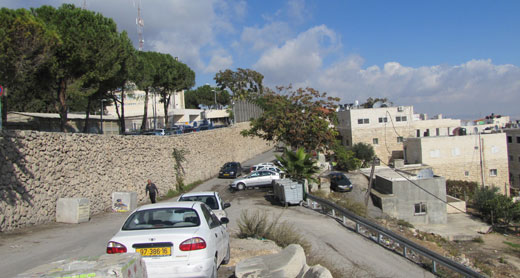
On the right, in gray: the Darwishes' home. On the left: the fence of the Hadassah Mt. Scopus Hospital parking lot. Photograph: 'Amer 'Aruri, B'Tselem, 14 October 2012.
Amir’s mother informed B'Tselem that the investigator told her son that there was video footage showing him throwing stones at cars in the hospital parking lot. However, the policemen did not show this footage to him or to his mother, despite her demand to watch it. After about an hour, the investigator told Amir’s mother that she could take her son home.
Amir’s mother said that after his release, Amir complained of headaches, nausea and dizziness. So she took him in for a medical checkup. She added that, following the incident, Amir suffered nightmares. In addition, for several nights he was afraid to sleep alone in his own bed and asked to sleep with his parents.
Israeli law, which applies to Israeli authorities also in East Jerusalem neighborhoods, sets the age of criminal responsibility at 12. Therefore, a nine-year-old suspect may not be detained.
The minor’s family decided not to file a complaint with the Department for the Investigation of Police (DIP) concerning the attack on Amir and his unlawful detention. According to the family, a prior complaint filed with the DIP concerning the violent detention of another of their sons was not properly addressed. Consequently, they told B’Tselem, they saw no point in filing a complaint in this case.
Investigation by B’Tselem East Jerusalem field researcher ‘Amer ‘Aruri.


