Demonstrations

One year on, investigation into the killing of Mustafa Tamimi still not completed

Update: On 11 December 2011 B’Tselem was informed that an MPIU investigation had been opened. On 6 February 2013 the MAG Corps informed B’Tselem that the case had been returned to the MPIU to complete investigation of certain additional matters. On 5 December 2013 the MAG Corps informed B’Tselem that the case had been closed because the gunfire that had killed a-Tamimi “was carried out in accordance with the relevant rules and regulations, and did not involve any wrongdoing.”

A year after the killing of Mustafa Tamimi, resident of the West Bank village of a-Nabi Saleh, who was fatally injured in the head by a tear gas canister, B’Tselem contacted Military Advocate for Operational Matters Lt. Col. Ronen Hirsch, demanding clarification of the status of the case. The organization served notice that it intends to seek legal remedy as may be required to end the delays in pursuing this case and prevent damage to the rights of the complainants and to the criminal process.

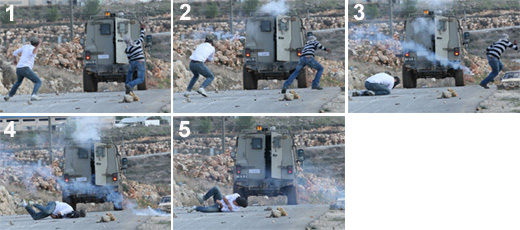
Photographs of the firing directly at a-Tamimi, by Haim Scwarczenberg, 9 Dec. '11.

Nearly one year ago, on 9 December 2011, an Israeli soldier shot a tear gas canister at very short range at Mustafa Tamimi during a demonstration in a-Nabi Saleh. Tamimi, critically injured, was taken for treatment at Beilinson Hospital and died of his wounds the next day. On the same day the incident took place, B’Tselem submitted a complaint to the Military Police Investigations Unit in Jerusalem. The MPIU opened an investigation two days later. Nonetheless, the Advocate for Operational Matters has yet to announce a decision on whether to serve an indictment or close the case. To the best of B’Tselem's knowledge, the investigation continues. The explanation provided to B’Tselem to justify the lengthy process is that “this is an operational inquiry, complicated and challenging, and decisions arrived at during it, which influence its duration, are taken in a matter-of-fact manner based solely on the needs of the inquiry and the quest for the truth.”

Noa Tal, Director of the Data Department at B’Tselem, noted in her letter that even had this explanation been acceptable some two months after the incident, an inquiry lasting a period of nearly one year cannot be considered reasonable. The longer the process is drawn out, the greater the damage to the prospects for an effective criminal proceeding, inter alia because some of the evidence will no longer exist and the witnesses’ recollections are liable to be less acute. Thus grave harm is done to the principle of the rule of law and the deterrent value for discouraging similar acts in the future.

Suggested items

עשן מצמיגים שהבעירו מפגינים פלסטינים מיתמר מעל המאחז אביתר. צילום: אמיר כהן, רויטרס, 23.6.21

Open-Fire Policy

Nine months of protesting a new outpost : seven killed and dozens injured in the town of Beita

In May 2021, Israel established a new settlement, known as the Evyatar outpost, on land belonging to the towns of Beita and Qabalan and to the village of Yatma atop Mount (Jabal) Sabih. The move was carried out by the settler movement Nachala, with the assistance of the Samaria Regional Council and the military's consent. Settlers previously tried to take over the land by establishing an outpost in 2013, 2016 and 2018, but the Civil Administration was quick to demolish the structures every time. This time, Israel left the outpost in place. The outpost controls an area of 36 dunams [1 dunam = 1,000 sq. meters], according to a calculation commissioned from Kerem Navot by B’Tselem. It partly covers private Palestinian land and partly land Israel considers "survey land." The outpost includes about 50 permanent structures, a playground, a synagogue, a religious study hall, a grocery store, a power grid and fully-paved roads. According to the outpost's Facebook page, it was established in order to create a wedge between the town of Qabalan and the village of Yatma, to the south of Route 505, and the town of Beita to the north. In early July 2021, the outpost was evacuated after the settlers signed an agreement with the government. Under the agreement, all the structures in the outpost would remain in place and the settlers living in them would leave, while the government examined the status of the land. If it transpired that the outpost could be "legalized," some of the settlers would be able to return, and a military yeshiva program (hesder) would be established there. As part of the agreement, the military maintains a permanent presence at the outpost. Even prior to a decision regarding "legal" approval of the outpost, and ever since it was established, the military has prevented Palestinian farmers from accessing hundreds of dunams of their land adjacent to it. This restriction affects about 80 families of farmers from Beita and Yatma. In August 2021, the Israeli High Court of Justice denied a petition filed by the Palestinian landowners against the establishment of the outpost, on the grounds that land ownership in the area was still under examination. The examination was completed, according to media reports, in October 2021. In recent weeks, the media have reported that the state is considering a "compromise" according to which the yeshiva that was dismantled in the outpost of Homesh will be rebuilt in Evyatar. Just before the end of his term, the outgoing attorney general approved the "land survey" results and expediting planning procedures at the site. The government can now, according to its logic, go ahead with “legalizing” the outpost and founding the yeshiva there. The town of Beita, on whose land the outpost was established, lies south of the city of Nablus and is home to some 9,000 Palestinians. Since the outpost was established, the town residents have been protesting the takeover of their land. They hold nightly demonstrations on the outskirts of the town, as well as mass protests on Fridays, which include a march towards the outpost with hundreds, and sometimes thousands, of participants. Prayers are held at the beginning of each protest, usually followed by clashes in which young Palestinians light tires and throw stones at Israeli security forces. The latter violently suppress the protests with massive amounts of tear gas – scattered also from drones and jeep-mounted launchers – and fire rubber-coated metal bullets, sponge rounds and live ammunition, including 0.22-inch caliber bullets (Two-Twos) issued by snipers. To date, seven residents of Beita have been killed over the course of the demonstrations or in close proximity to them. In addition, according to UN figures1, about 180 people have been injured by live fire, another 1,000 or so by "rubber" bullets and sponge rounds, and more than 4,200 have suffered from tear gas inhalation. Another Beita resident was killed near the town's water mains. A resident of Yatma was killed during a demonstration against the establishment of the outpost held in his village. In addition to implementing a lethal open-fire policy, Israeli security forces have arrested dozens of town residents since the protests began. To wear down the protesters, the military closed off the main entrance to the town for a month and a half, and military bulldozers blocked and dug up agricultural roads leading to the demonstration flashpoints, damaging about a kilometer of agricultural terraces and some 2,000 trees about a kilometer away from the outpost. The deputy council head of Beita told B'Tselem that Israel revoked the work permits of about 150 residents. Soldiers also used severe violence against Israeli protesters who came to the demonstrations to show solidarity with the Palestinian protesters, and arrested them on false pretenses. Evyatar was established on Palestinian land – not on the private initiative of several settlers, but as part of Israel's settlement policy in the West Bank, with the full cooperation of all the relevant Israeli authorities. However, the state is not content with appropriating the land and building a settlement there. It also insists on forbidding the Palestinian residents from protesting these acts and forcibly prevents any attempt at resistance — including with lethal force. Let us reiterate: the establishment of settlements is illegal under international law, and the International Criminal Court in the Hague is currently investigating Israel’s policy on the matter. Israel's choice to prevent area residents from protesting the establishment of Evyatar, to implement a lethal open-fire policy in circumstances that do not endanger soldiers' lives, and to uphold this policy even after its fatal outcomes have become clear – adds insult to injury. * Database on the protection of civilians of the UN Office for the Coordination of Humanitarian Affairs (OCHA). B'Tselem field researcher Salma a-Deb'i collected the following testimonies from people who witnessed the killing or wounding of town residents during the protests: 10 December 2021: The killing of Jamil Abu 'Ayash, 32 On Friday, 10 December 2021, at around midday, Beita resident Jamil Abu ‘Ayash (32) arrived at the area where the demonstration was taking place that week. The site is known as al-Hutah and lies about 700 meters from the Evyatar outpost. At around 2:30 P.M., Abu ‘Ayash was shot by a soldier from a distance of 200 meters away, while holding a slingshot. In a testimony he gave on 12 December 2021, A.S. (33), a resident of Beita who was at the scene, recounted: At around 2:20 P.M., I was standing talking to some young guys. There were a lot of soldiers and Border Police officers on the hill opposite us, firing tear gas canisters and "rubber" bullets. About 10 soldiers were standing about 200 meters away from us. The young guys who were throwing stones at them were very far away from them, and the stones didn't even reach them. I saw that two soldiers joined them. They advanced, and one of them lay down on the ground in a sniping position. Then he got up, they drew back, and the same thing happened again. After 10 minutes, I saw Jamil Abu 'Ayash pass by us and stop about 50 meters ahead. He was holding a slingshot. Only a few minutes passed, and then one of the two soldiers, who was in front and lying on the ground, opened fire. I heard several shots, one after the other. We all ducked or lay flat on the ground. As soon as I raised my head, I saw Jamil lying on the ground and heard the guys shouting. Some of them picked him up, and at the same time, soldiers fired a lot of tear gas at the area. Jamil's head and face were covered in blood. He was taken to an ambulance and then to hospital in Nablus. I drove to the hospital, and the doctors there told me that he'd lost part of his brain. In that kind of situation, when a guy is critically injured, 80% of the protesters leave the demonstration and go to the hospital, and that's how the soldiers manage to stop the demonstration. S.H. (29), a resident of Beita, arrived at around midday to the prayers, from which the weekly demonstration set out half an hour later. In a testimony he gave on 15 December 2021, he described what happened: When we got to the area called al-Hutah, we saw a lot of soldiers spread out on the hill. There were seven or eight soldiers opposite us, about 150 meters away. They were firing a lot of tear gas and some "rubber" bullets. There were two military jeeps next to them, and soldiers inside them were firing tear gas from launchers. The young guys started throwing stones at the soldiers. At around 2:30 P.M., I saw two soldiers about 200 or 250 meters away from us. One of them was lying on the ground, and the other was showing him where to aim. We hid behind a stone wall. After a few minutes, the soldier took up a sniping position again. We sat down on the ground. I saw Jamil Abu ‘Ayash coming. I hadn't seen him at the demonstration earlier. I told him to sit down and watch out, and then I heard a single shot and he fell over. He was a meter away from me. When I headed over to him, the soldier fired again and hit the stones in the terrace. I kept going towards Jamil. He had an entry wound in his forehead, with an exit wound at the back of the head. We picked him up and carried him about 500 meters to an ambulance that was waiting there. Border Police officers ran after us a bit and fired dozens of tear gas canisters in our direction. Because the military dug up the roads leading to the hill, the closest the ambulance could get to us was 500 meters. I later found out that he’d been killed. He was buried that day in the village cemetery. 24 September 2021: The killing of Muhammad Khabisah, 28 On Friday, 24 September 2021, at around midday, several hundred residents of Beita and of nearby villages set out for the weekly prayers and demonstration. After the prayers, some of the residents advanced about 800 meters towards the outpost, where they burned tires and threw stones at members of the security forces, who fired tear gas canisters and "rubber" bullets at them. Muhammad Khabisah (28), a resident of Beita, joined the stone-throwers. At around 3:00 P.M., Khabisah and several young people were sitting under an olive tree near the site of the demonstration. Several dozen meters away, a group of young men were throwing stones at security forces, who were sheltering behind a stone wall and occasionally stood up to fire tear gas canisters and "rubber" bullets at the young men. About half an hour later, a member of the security forces lay down in front of the wall and fired several live shots, hitting Khabisah in the head. He was taken to hospital, where the doctors failed to resuscitate him. In a testimony he gave B’Tselem over the phone on 11 October 2021, Khabisah's friend 'A. (21) related what happened that day: On Friday, 24 September 2021, we went to the prayers before the demonstration. After that, we set out towards the outpost, which is about 800 meters away. The soldiers were spread out in groups of three to five. We got near them. I was with Muhammad Khabisah and other young guys, and they were throwing stones at the soldiers. The soldiers fired tear gas and came towards us, and then we drew back, then we went ahead again, and so on. The soldiers also fired "rubber" bullets, and a few young guys that I didn't know were hit. Later, at around 3:30 P.M., Muhammad and I were resting with about six other young men under an olive tree. About 20 or 30 young men were throwing stones at three or four soldiers who were behind an agricultural wall. The soldiers fired live rounds, but they didn't hit any of us. We were calm, because the guys who were throwing stones were several dozen meters away from us and the soldiers were about 150 meters away from us, behind the young men. Then one of the soldiers lay down on the ground in front of the wall. One of the young guys warned us to watch out for him and said he might be about to kill someone. A few minutes later, I heard four or five shots. I ducked and after the shooting stopped, I raised my head. I saw Muhammad Khabisah lying on his side. I lifted his head and felt something move in his skull and his blood covering my hand. I shouted, "Muhammad!" The guys and I picked him up, but after a few meters I couldn't go on. I couldn't believe what happened. Y.H. (22), a resident of Beita, arrived at the demonstration around noon. In a testimony he gave on 11 October 2021, he recounted: At around 3:00 P.M., I sat down with some guys under an olive tree, about 50 meters away from the guys who were throwing stones, and about 150 meters away from three soldiers who were hiding behind a stone wall. When one of the soldiers wanted to fire tear gas or "rubber" bullets at the stone-throwers, he'd pop up behind the stones, shoot and duck back down. One of the guys said he was thirsty and that there was no water. Muhammad Khabisah, who was leaning against the tree trunk, called his cousin and asked him to bring water, but he didn't come in the end. After about half an hour, I saw a soldier lie down on the ground. I told the guys he was going to kill someone. Muhammad said we were far away from him. Only a few minutes passed, and then I heard four or five live shots. I ducked because it sounded close. When I raised my head, I saw Muhammad lying on the ground on his left side. I shouted, "Someone’s been hit, someone’s been hit." We went over to him and tried to pick him up, and some young guys came running and helped us. They took him from me. He was bleeding a lot from the back of his head and wasn't moving. They took him to an ambulance that was there, which took him to hospital. 6 August 2021: The killing of ‘Imad Dweikat, 38 On Friday, 6 August 2021, at around midday, about 700 residents of Beita and the nearby villages set out for the weekly demonstration against the outpost. At around 3:00 P.M., security forces fired at the protesters from 200 to 300 meters away, hitting Beita resident 'Imad Dweikat (38) in the chest while he was drinking a cup of water. Dweikat was taken to hospital, where he was pronounced dead soon after. J.D. (45), a resident of Beita, went to the prayers and the following demonstration with his brother (49). In a testimony he gave on 12 August 2021, he recalled: When we arrived, there were already 600 to 700 residents there. Some of them have deeds to the land that the settlers took over. Some of the residents went as far as 700 meters from the outpost. The soldiers were spread out in groups of five or six at the foot of the hill, and they were heavily firing tear gas canisters and throwing stun grenades. After that, they also fired "rubber" bullets. Several residents were injured, including my brother, who was hit in the leg by a "rubber" bullet while trying to give first aid to another resident, who had been hit by a "rubber" bullet in the knee. Even though he was hurt, my brother didn't leave to get treatment. I saw more residents being hit by "rubber" bullets and choking on the gas. At around 3:15 P.M., things calmed down a bit. My brother and I moved several dozen meters away from the clashes along with some other guys. We sat down under an olive tree and made coffee. Two ambulances were parked 20 meters away from us, and the soldiers were about 300 meters away from us. Things were quiet. Suddenly, I heard a shot. I looked over at the young guys who were throwing stones and saw one of the residents saying, "It can't be" and running in the opposite direction from the clashes. I saw someone lying on the ground and bleeding from the nose and mouth. Some young guys picked him up while shouting his name, 'Imad Dweikat. I realized it was a relative of mine. A little later, I learned he was dead. The news devastated me. He was very far away from the clashes. He was a father of four girls. The eldest is 10 and the youngest is a month and a half old. He worked hard to support his little children, and his whole life was devoted to his family. I was very saddened by his death. K.B. (31), a resident of Beita, also went to the prayers and the demonstration at around noon. In a testimony he gave on 22 August 2021, he related: At around 3:15 P.M., I was far away from the young guys who were throwing stones. Two ambulances were standing a few meters away from me, on standby to evacuate wounded people. I spoke with 'Imad, and then a guy went by carrying small cups of water with a lid. 'Imad took a cup, opened it and started drinking, and then he fell face down on the ground. He was two meters away from me. I thought he'd passed out from sunstroke. I turned him over on his back and saw that he was bleeding from the nose and mouth and had blood on his shirt. I screamed as hard as I could, "There's a wounded man here, guys!" and then several guys ran over and helped me carry 'Imad to one of the ambulances. I was shocked by what happened. I didn't hear any shots. 'Imad didn't do anything. He was just drinking water and was very far from the guys at the front of the demonstration, some of whom were throwing stones. The soldiers were about 200 to 300 meters away from us, and we were 70 to 80 meters away from the guys who were throwing stones. I thought I was a strong guy, who doesn’t get easily rattled, but what happened shocked me. A man standing next to me and talking to me was shot while doing nothing but drinking water. 16 June 2021: The killing of Ahmad Bani Shamsah, 15 On Wednesday, 16 June 2021, at around 5:30 P.M., several young men, including Ahmad Bani Shamsah (15), went to the area of Jabal Sabih to prepare tires for lighting at the nightly demonstration held at the spot. The young men went up to several hundred meters from the outpost, and about 150 meters from several settlers and a soldier who were in the area. Bani Shamsah hung a Palestinian flag on one of the olive trees and started to run away. At that point, a soldier shot him, hitting him in the back of the head. Bani Shamsah died of his wounds the following day. His friend, M.H. (16), recounted in a testimony he gave: The other young guys and I decided to go a little further to see where the soldiers were. We wanted to wave the Palestinian flag as close to them as possible, to provoke them. We walked up to about 500 meters from the outpost. We saw about 10 settlers and a soldier about 150 meters away from us. My friend, Ahmad Bani Shamsah, hung a Palestinian flag on an olive tree, and we started to shout "Allahu Akbar." That's what we always do when the soldiers see us, and also to let everyone know there are soldiers around. The soldier fired several shots in our direction, and we all ran away. I heard Ahmad say he'd been hit. I stopped and looked around, and saw him lying on the ground 10 meters away. I went over to help him, but then the soldier fired at me. I moved away and hid behind a boulder. Meanwhile, another young guy arrived and the two of us decided to go ahead together to pick Ahmad up. When we reached him, he was bleeding heavily from his head. More guys came and helped us take him to a nearby car, and from there an ambulance took him to hospital. I got into a car to go to the hospital, but I was so shocked that I asked the driver to take me home. At home, I waited to hear news about Ahmad, even though I knew he was dead. It took a few days to get my appetite back. I lost two friends in less than a week – Ahmad and Muhammad Hamayel. It's hard and incredibly cruel. 14 May 2021: The killing of 'Issa Barham, 40 The first demonstration by Beita residents against the establishment of the Evyatar outpost was held on Friday, 14 May 2021. Soldiers who were spread out on the hill fired tear gas canisters and "rubber" bullets, and later live ammunition, at the protesters, some of whom threw stones at the soldiers from hundreds of meters away. Several residents were injured by live fire. 'Issa Barham (40), a resident of Beita, arrived to help evacuate the wounded people. He was shot in the chest from a distance of about 70 meters away, while standing by his car. In his testimony, 'Issa's relative A.B. (41) described what happened: On Friday, 14 May 2021, at around 1:30 P.M., I went to the demonstration on Jabal Sabih, south of the village, against the establishment of the Evyatar outpost. I saw about 10 soldiers and seven or eight settlers standing far away from them. The soldiers were standing watching from afar, firing tear gas canisters and throwing stun grenades even before we got near them. We were about 300 meters away from the soldiers, and the stones that the guys were throwing didn't even reach them. The soldiers fired live bullets at us and injured several residents, all in the upper body. The ambulances took two of the wounded people way, but when more people got injured, we asked residents to take them away in private cars. I saw a relative of mine, 'Issa Barham, arrive in his car from the direction of the village. I asked him, "What brought you here?" and he answered, "Where are the wounded people?”. He immediately turned his car around, so he could drive away quickly. I told him, "The wounded people were taken in the Mashtubah (unlicensed vehicle) of one of the residents, because that's what we had here." 'Issa parked the car, got out and stood next to it. Then I saw one of the soldiers crouch in a sniping position and fire at us. At that point, things had already calmed down and were quiet. Everyone was busy with the wounded people or waiting to hear news about a critically injured resident. It never occurred to me that the soldier would shoot. Suddenly, I heard a single shot and saw 'Issa fall backwards. I ran over to him and when I took off his clothes, I saw blood in the center of his stomach. The guys and I called an ambulance, picked him up, carried him a short distance and put him in an unlicensed car that was there so he could be taken to hospital. A short while later, the car drove off and met an ambulance that took 'Issa away. I got into my car right away and drove to the village clinic, because I thought the ambulance had taken 'Issa there, but I didn't find him there. I was told he’d been transferred to hospital in Nablus. When I got to the hospital, I was told 'Issa had been killed. It was a terrible shock. A man who came to help the wounded was shot and killed. He was a prosecutor at the district attorney's office, and a father of four children between the ages of 1.5 and eight. He was a wonderful man. The whole town loved him. He helped everyone and was a kind person. R. (36) went to the prayers and to the following demonstration. In a testimony he gave over the phone on 9 June 2021, he related: Several residents were critically injured by the soldiers' gunfire, one after the other, all in the upper body. We had trouble evacuating the many wounded people, and some were taken away in private cars. People were called over the mosque's loudspeakers and on social media to come and help drive the wounded people to hospital in private cars. I saw 'Issa Barham standing with his hand in his pockets. His clean, neat clothes made it clear that he wasn’t a man who was taking part in the clashes. He was standing and watching the young men from a distance. I was about 15 meters away from him, and the soldiers were 70 to 80 meters away. Suddenly, I saw him fall down. The young men ran over to him, picked him up and carried him to one of the cars. I got into the car with him, along with some other guys. I slapped him to wake him up, but he didn't wake up. I lifted the clothes off his stomach and saw that he was bleeding. We met an ambulance after about 50 meters, and he was put in it. A short while later, it was announced he’d been killed, and most of the residents went back to the village to attend the funeral and support his family. 25 June 2021: The injuring of Samer Khabisah, 18 On Friday, 25 June 2021, at around midday, Samer Khabisah (18) from Beita arrived at the prayers ahead of the weekly demonstration. In a testimony he gave on 25 October 2021, Khabisah related that during the prayers, soldiers were already firing tear gas canisters at the residents with a drone. He went on to describe what happened during the demonstration: The soldiers split up into groups of eight or so, and continued to throw stun grenades and fire tear gas canisters at us. The young guys hurled the stun grenades back at them and threw stones at them. Several residents were hurt by inhaling the gas. At some point, I joined the young guys and covered my face with a shirt because of all the gas. I saw a military jeep come from the direction of the outpost and stop, and the young guys started throwing stones at it. I also saw four soldiers 30 to 40 meters away from the jeep, firing live bullets at the young guys. Then I blacked out. I woke up at al-Istishari Hospital in Ramallah, after 12 days in the ICU. I couldn't move or talk. I didn't understand what was happening or why I was there. I later found out I'd been hit in the face by live fire and that I had a lot of shrapnel lodged in my head. Even after five operations, the doctors didn't manage to get all of it out. I was in hospital for 35 days, 22 of them in the ICU. The whole time, I couldn't breathe, and they made a hole in my neck instead. I couldn't eat or talk, either. They put a device in my jaw to set it, and part of my tongue was amputated. After I was discharged, I only ate ground food through a straw. I only have eight teeth left and they still have to be set, too. I've had three operations, and I'll have to go through a few more. My doctor says it'll take at least two years to complete the treatment. I need a bone graft in the lower and upper jaw and a dental implant. I've been having speech therapy for three months, because I couldn't utter words or even syllables after I was injured. People didn’t understand what I was saying, and I had to repeat things several times for them to understand. My plan was to go to America and work for my uncle. I wanted to get to know other places. I've never traveled or left the West Bank. Now, I'm no longer sure I can travel. My whole life has been disrupted. 5 November 2021: F.M. (19) injured in the eye by a "rubber" bullet On Friday, 5 November 2021, at around 1:30 P.M., F.M. (19) from Beita arrived at the weekly demonstration, which was attended by several hundred people. In a testimony he gave on 25 November 2021, he described losing his eye from being hit by a "rubber" bullet: When the demonstrators were 150 to 200 meters away from them, the soldiers started firing tear gas canisters. They fired 15 or 20 canisters and most of the guys dispersed. Some of them grabbed the tear gas canisters and threw them back at the soldiers. It went on like that for about half an hour. The soldiers also fired "rubber" bullets, but no one was hurt. The other young guys and I went towards the soldiers, reaching up to about 100 meters from them. One of the soldiers kept heading towards us and then backing away. I was afraid he'd shoot at us, so I hid with a few other guys behind a dirt mound that the soldiers put there to stop the protesters from advancing towards the hill and the outpost. Every time, I threw stones and then went back to hiding behind the mound. I was looking at soldiers who were firing gas canisters that were landing far away from me when suddenly, I was hit in the left eye and started bleeding. I was sure I'd lost my eye. The guys picked me up and walked a long way to an area the ambulances could reach, because the military had dug up the land with a tractor and vehicles couldn't get there. I was taken in an ambulance to a-Najah hospital in Nablus, where I was treated and X-rayed. The doctor said the "rubber" bullet had penetrated my eye. After three hours, they operated on me and took the bullet out along with the eye. I was discharged the following afternoon. Now I need surgery at a hospital in Jerusalem to have a prosthetic eye put in. My mother is still crying. She can't believe I lost my eye. Right now I'm at home, and friends and relatives come to visit. I still don't know what my life will look like after the injury, without one eye. * * * Since the outpost of Evyatar was established on the land of Beita, Qabalan and Yatma, Israeli forces have killed nine Palestinians: ‘Issa Suliman Barham Barham A 40-year-old resident of Beita. Killed on 14 May 2021. Soldiers shot and wounded him in the abdomen while he was standing near his car, during a demonstration against the establishment of the outpost on town land. Died of his wounds a short while later. Investigation status: On 23 June 2021, media reports stated that an MPIU investigation had been launched. On 1 June 2022, the IDF Spokesperson informed B’Tselem that the case was still under investigation. Tareq ‘Omar Ahmad Snobar A 27-year-old resident of Yatma. Wounded on 14 May 2021 and died on 16 May 2021. Soldiers shot him in the chest while Palestinians were throwing stones at them at the entrance to the village of Yatma, to protest the establishment of the outpost and Israel’s operation in the Gaza Strip. Investigation status: On 3 June 2021, media reports stated that an MPIU investigation had been launched. On 18 November 2021, media reports stated that the case was still under investigation. On 1 June 2022, the IDF Spokesperson informed B’Tselem that the case was still under investigation. Zakaria Maher 'Abd al-Hamid Fallah A 25-year-old resident of Beita. Killed on 28 May 2021. Soldiers shot him in the chest during a demonstration against the establishment of the outpost on town land. Investigation status: On 23 June 2021, media reports stated that an MPIU investigation had been launched. On 1 June 2022, the IDF Spokesperson informed B’Tselem that the case was still under investigation. Muhammad Sa’id Muhammad Hamayel A 16-year-old resident of Beita. Killed on 11 June 2021. Shot by soldiers during a demonstration against the establishment of the outpost on town land. Investigation status: On 23 June 2021, media reports stated that an MPIU investigation had been launched. On 1 June 2022, the IDF Spokesperson informed B’Tselem that the case was still under investigation. Ahmad Zahi Ibrahim Bani Shamsah A 15-year-old resident of Beita. Wounded on 16 June 2021 and died on 17 June 2021. Soldiers shot him in the back of the head after he hung a Palestinian flag on a tree, in an area where Palestinians demonstrate against the establishment of the outpost on town land. Investigation status: On 23 June 2021, media reports stated that an MPIU investigation had been launched. On 1 June 2022, the IDF Spokesperson informed B’Tselem that the case had been sent to a military prosecutor for review. Shadi ‘Omar Lutfi Salim A 41-year-old resident of Beita. Killed on 27 July 2021. Soldiers shot him near the town’s water mains. The next day, metal plumbing tools were found on the spot. Salim, who was a plumber, had gone there several times before to fix the mains. He died of his wounds a short while later. Israel held his body until 10 August 2021. Investigation status: On 6 August 2021, media reports stated that an MPIU investigation had been launched. On 19 November 2021, media reports stated that the case was still under investigation. On 1 June 2022, the IDF Spokesperson informed B’Tselem that the case had been sent to a military prosecutor for review. ‘Imad ‘Ali Muhammad Dweikat A 38-year-old resident of Beita. Killed on 6 August 2021. Israeli security forces shot him in the chest from several hundred meters away, during a demonstration against the establishment of the outpost on town land. Investigation status: On 12 August 2021, media reports stated that an MPIU investigation had been launched. On 19 November 2021, media reports stated that the case was still under investigation. On 1 June 2022, the IDF Spokesperson informed B’Tselem that the case was still under investigation. Muhammad ‘Ali Muhammad Khabisah A 28-year-old resident of Beita. Killed on 24 September 2021. Israeli security forces shot him in the head during a demonstration against the establishment of the outpost on town land. Investigation status: On 1 June 2022, the IDF Spokesperson informed B'Tselem that an MPIU investigation had been launched. Jamil Jamal Ahmad Abu ‘Ayash A 32-year-old resident of Beita. Killed on 10 December 2021. Soldiers shot him in the head from 200 meters away during a demonstration against the establishment of the outpost on town land. Died of his wounds a short while later. Investigation status: On 24 December 2021, media reports stated that an MPIU investigation had been launched. On 1 June 2022, the IDF Spokesperson informed B'Tselem that the case was still under investigation.

28 February 2022

ירי גז בהפגנה ממזרח לעיר עזה. צילום: מוחמד סבאח, בצלם, 27.4.18

Open-Fire Policy

Security forces make deadly use of crowd control weapons in Gaza

From the beginning of the Great March of Return protests on Land Day, 30 March 2018 until the end of June 2019, Israeli security forces killed 216 Palestinians, 43 of them minors, and wounded thousands, the vast majority with live ammunition. However, security forces also make deadly use of crowd control weapons, including tear gas canisters which are not designed to hit people directly. At least seven of the Palestinians killed died as a result of a teargas canister hitting their head or face directly. Four of them were minors. According to the OCHA Protection of Civilians Database, as of 28 June 2019, more than 1,600 Gaza protestors arrived in hospital with injuries resulting from direct teargas canister hits, more than a third of them in the first three months of 2019. Teargas canisters are a crowd control weapon with a firing range spanning 100 meters to several hundred meters, in the case of extended range canisters. They are designed to be non-lethal and the open-fire regulations, at least officially, as well as use instructions, forbid firing them directly at people due to the grave danger involved. In the past few months, B’Tselem’s field researchers in the Gaza Strip collected testimonies from protestors who were injured by teargas canisters and eyewitnesses. These testimonies indicate that security forces routinely fire teargas canisters directly at protestors, in contravention of the regulations. The testimonies also indicate teargas canisters are fired from elevated positions, relative to the perimeter fence (earth embankments, or the roofs of military jeeps), or through gaps in the fence itself. B’Tselem has documented direct firing of teargas canisters in the West Bank, which resulted in severe injuries and killed at least two people. Firing tear gas canisters directly at protestors is not a stand-alone practice. It is part of the open-fire policy Israel has been implementing along the Gaza border for more than a year. This policy, which has so far claimed the lives of more than 200 protestors and injured thousands is patently unlawful and immoral. Using lethal fire, whether live or otherwise, against protestors the vast majority of whom are unarmed and pose no danger to the lives of armored security forces on the other side of the fence, in the same way for more than a year, despite its well-documented horrific results is yet another expression of Israel’s disregard for the lives and bodily integrity of Palestinians. Muhammad Fseifes, 21, injured in head – 31 May 2019 At about 3:00 P.M. on Friday, 31 May 2019, Muhammad Fseifes, 23, a resident of ‘Abasan al-Kabirah who is unemployed, arrived at the protest near the Gaza perimeter fence to the north of the town of Khuza’ah. At about 3:30 P.M., Fseifes and a group of young men, some waving Palestinian flags, moved forward to a spot a few dozen meters from the fence. Hanan Abu Tibah, 30, a resident of Bani Suheila, married and mother of four, also went with the group, waving a Palestinian flag. In a testimony taken on 19 June 2019 by B’Tselem field researcher Khaled al-‘Azayzeh, Abu Tibah related: Muhammad Fseifes was with us. We shouted slogans and then the soldiers started to fire teargas canisters at us from a launcher mounted on one of the military jeeps. The gas canisters fell next to us and we moved back. Then we moved forward again and stood at the same spot, and the soldiers fired sponge-tipped rounds at us. Muhammad Fseifes was hit in the shoulder, chest, and leg. Medics who arrived on the scene took him away and treated him in the field. Ten minutes later, Muhammad came back and stood with us, a few dozen meters away from the fence. There were a few young men and women around us. At about half past four, I saw a woman soldier standing near the fence. She fired three or four teargas canisters at us through gaps in the fence. I was standing a few meters in front of Muhammad. I looked back and saw him fall after a canister hit him in the head. I went over to him. His head was bleeding badly and his skull was fractured. I called out to the medics and signaled to them with the flag I was holding. A few medics and young guys came over. They bandaged Muhammad’s head and evacuated him to an ambulance on a stretcher. In a testimony taken on 19 June 2019 by B’Tselem field researcher Khaled al-‘Azayzeh, Fseifes stated: I woke up after six days and found myself in the intensive care unit at the European Hospital. I saw my father next to me. He asked me if I recognized him and I said yes. The next day they moved me from intensive care to neurosurgery. The doctors told me that I might be left paralyzed on the right side of my body. When I heard that I went into shock. I was really scared. But by the next day I could already move my body and my limbs. I was happy, despite the pain from the injury. A few days later they let me go home. I’m still taking pills and I’m being monitored at the hospital. I have 13 stitches on the right side of my head. Sometimes it hurts so much that I feel as though my head is about to explode. Sometimes I feel dizzy and I have to sit down right away, even on the floor. I’m afraid that I’m going to have these symptoms for a long time. Volunteer medic Muhammad Abu Jazar, 21, injured in jaw – 8 March 2019 At about 3:30 P.M. on Friday, 8 March 2019, volunteer medic Muhammad Abu Jazar, 21, a resident of Khan Yunis, arrived at the demonstration to the north of the town of Khuza’ah. While he was on the way to evacuate an injured person a few dozen meters from the perimeter fence, a gas canister struck him in the jaw. In a testimony taken on 10 March 2019 by B’Tselem field researcher Khaled al-‘Azayzeh, Abu Jazar stated: When I arrived that day there were only a few demonstrators. Usually the number of demonstrators increases after four o’clock. A few dozen demonstrators moved forward to a spot about 30 meters from the barbed wire fence. I was standing with a group of medics from various medical teams, all of us wearing official medics uniforms, about 25 meters behind the demonstrators. We deliberately keep our distance in order not to be hit by the bullets and gas they fire at the demonstrators. At about four o’clock, one of the demonstrators who were near the barbed wire fence was hit in the leg by a live bullet. Medics who were close by called me to come over, because I had a stretcher. I ran over there, but in the meantime another medic had gotten there first and put the injured guy on his stretcher. Together with some other medics, we helped him to evacuate the injured guy. While we were walking toward the ambulances, which were parked on Jaker Road, I saw someone about 20 meters away from me who had been injured in the head by a gas canister. I left the first injured guy and went up to this guy with a stretcher, together with two other medics. I moved a few meters toward him, and then soldiers fired teargas canisters in our direction. I felt the canister hit me in the jaw. I let go of the stretcher and put my hand to my jaw. I felt a strong pain in my jaw and my head was also hurting, and I felt dizzy. The two medics who were behind me grabbed me so that I wouldn’t fall to the ground. They helped me run far away from the gas. I was half unconscious and after they evacuated me I lost consciousness. I woke up in Nasser Hospital in Khan Yunis. The doctors told me that my jaw wasn’t broken. They treated me and gave me painkillers. At half past seven they discharged me from hospital and I went home. My jaw still hurts, especially when I eat, and I suffer from headaches and dizziness. On 10 July 2019, Abu Jazar updated B’Tselem field researcher Khaled al-‘Azayzeh that he was still suffering from pain from the wound and from headaches. When the headaches are particularly bad, he takes injections of painkillers. ‘Omar a-Najar, 26, married and father of two, is a resident of Bani Suheila and a volunteer medic. A-Najar was with Abu Jazar when he was injured. In a testimony taken on 4 April 2019 by B’Tselem field researcher Khaled al-‘Azayzeh, he stated: At about four o’clock, a few dozen people moved forward to a point about 30 meters from the barbed wire fence, shouting slogans. A few of them threw stones at the soldiers, who climbed up onto higher earth embankments behind the fence. There were also a few military jeeps behind the fence, and two of them fired teargas canisters. A soldier who came out of the roof of one of the jeeps fired gas canisters directly at the people. We were standing about 30 meters behind, to the west of the demonstrators. One of the guys, who was close to the concertina fence, was hit in the leg by live fire. Together with Muhammad and other medics, we gave him first aid and he was evacuated on a stretcher. As we headed west, we saw an injured man who had been among the demonstrators who approached the fence and had been hit by a gas canister fired by the soldier on the roof the jeep. The man was hit directly in the left eye, I think, and fell to the ground. Muhammad and I were close to him and Muhammad had a stretcher. We moved toward him and then Muhammad was also hit by a gas canister fired by the soldier on the roof of the jeep. He fell and I caught him. He put his hand to his cheek. The canister that had hit him started to smoke only after it hit him and fell on the ground. I gave Muhammad first aid while he was lying on the ground. He was in a lot of pain. Then some more medics arrived, and we evacuated him on a stretcher to an ambulance parked on Jaker Road. He was still conscious. Then I went back into the field and stayed there until about seven o’clock. Most of the injuries I saw that day were caused by direct hits by teargas canisters. Some people were injured after inhaling gas. The killing of Bassam Safi, 22, and the injuring of photographer Munib Abu Hatab, 23, in the stomach – 22 February 2019 On Friday, 22 February 2019, two people were injured by teargas canisters fired directly by soldiers at demonstrators during a protest to the north of the town of Khuza’ah. Bassam Safi, 22, a resident of Khan Yunis Refugee Camp, was injured at about 5:00 P.M. by a teargas canister that lodge in his face. Video footage posted on social media shows Safi lying on the ground in an area close to Jaker Road, about 150-200 meters from the fence, smoke pouring out of his head. Safi was taken to the European Hospital to the south of Khan Yunis where he underwent surgery to extract the canister. He remained unconscious, in hospital, until he died of his injuries on 11 March 2019. In a testimony taken on 1 March 2019 by B’Tselem field researcher Khaled al-‘Azayzeh, Muhannad a-Najar, 19, a computer science student and resident of Khan Yunis, described the incident: There were four or five military jeeps on the other side of the fence, and two of them fired heavy volleys of teargas canisters at the demonstrators. There were also a few soldiers who were firing teargas canisters using launchers. From my experience at the demonstrations, I’ve learned that the gas canisters fired by soldiers with launchers reach a very large distance and sometimes land in the area of the March of Return Protest tents. The range of the teargas canisters fired from the jeeps is limited and they move more slowly, so the demonstrators manage to dodge them. On that day, the soldiers also fired live ammunition, injuring several people. I saw lots of people who’d been injured after inhaling teargas. Between half past four and five o’clock, I stood in the area near Jaker Road eating sunflower seeds. A guy was standing a few meters behind me, and I later learned that his name was Bassam Safi. He wasn’t doing anything. The soldiers on the embankment fired a few teargas canisters, one of which hit Safi directly in the head. When I turned around, I saw him lying on the ground on his back. A lot of gas was coming out of his head. I ran to him to help, but what I saw and the gas coming from his head shocked and scared me and I couldn’t go any closer. I took out my phone and filmed what was happening. After the gas clouds dispersed, some civilians and medics approached the injured guy. I think they were from the Red Crescent. They put him on a stretcher and evacuated him to an ambulance parked on Jaker Road. Munib Abu Hatab, 23, a photojournalist and resident of Khan Yunis, arrived at the demonstration area at around 3:00 P.M. In a testimony taken on 27 February 2019 by B’Tselem field researcher Khaled al-‘Azayzeh, he stated: At about five o’clock on Friday, 22 February 2019, I saw a soldier fire a gas canister toward the demonstrators. Then I saw the demonstrators run toward one of the injured people. I also ran over because I was far away from them. When I reached them, I saw a young man lying on the ground, about 200 meters from the fence. A lot of smoke was coming out of his head. The young guys were trying to stop the gas and give him first aid. I later learned that the young man transferred to the ambulance was Bassam Safi. A few minutes later, I moved toward the fence to photograph the demonstration and the demonstrators. When I reached a point about 100 meters from the concertina fence, I saw over a hundred demonstrators in the area 50-100 meters from the fence. I had two cameras with me. One of the soldiers got out of the military jeep, aimed his canister launcher directly at me, and fired a gas canister that hit me in the right side of my stomach. I fell down on my back. The camera was behind my back and I fell on top of it. I was in a lot of pain and I started screaming in pain. I felt something burning inside my body. I was sweating a lot and felt dizzy. As soon as I fell down and started shouting, some medics and young guys came over to give me first aid. They bandaged me, put me on a stretcher, and took me to an ambulance on Jaker Road. From there the ambulance took me to the medical tent where some doctors checked me and evacuated me to the European Hospital in Gaza City. I arrived at the hospital with burns and swelling at the point of the injury. They let me go home a few days later. During my work as a photojournalist covering the March of Return Protests, I’ve noticed that lately the occupation soldiers have been targeting their gas launchers directly at the demonstrators and fire at them in order to hit them, rather than disperse them. Jibril al-Kafraneh, 14, injured in head – 22 February 2019 On Friday, 22 February 2019, Jibril al-Kafraneh, 14, a ninth grade student from Beit Hanoun, arrived at a demonstration to the east of Jabaliya Refugee Camp. At about 16:00, a gas canister struck al-Kafraneh in the head and he lost consciousness. He was evacuated to the Indonesian Hospital close the refugee camp and was then transferred to a-Shifa’a Hospital in Gaza City. Ahmad a-Za’anin, 27, an electrician and resident of Beit Hanoun who is married with two children, was present on the scene. In a testimony taken on 5 March 2019 by B’Tselem field researcher Olfat al-Kurd, a-Za’anin described the incident in which al-Kafraneh was injured: I was standing about 200 meters from the fence. I wasn’t moving forward because the Israeli military was firing a lot of teargas and even live ammunition at the demonstrators. I know Jibril al-Kafraneh from Beit Hanoun and I saw him there. Between half past three and four o’clock, I saw my cousin get injured in his left leg by two bullets and fall down. At the same moment, I also saw Jibril al-Kafraneh get hit by a gas canister that struck his head and ricocheted back. He was a meter or a meter and a half from me and he also fell down. I didn’t know who to run to and help first, Jibril or my cousin. All the demonstrators ran away because of the gas canisters. I rushed over to Jibril, who was lying unconscious on the ground, his head and faced covered in blood. I picked him up and took him to an ambulance that was a few meters away. I went straight back to give my cousin first aid, and I took him to an ambulance, too. I got into the ambulance with Jibril. He was unconscious and the medics were giving him first aid. They bandaged his head and hooked him up to an oxygen supply. We reached the medical tents, but because his injury was so serious, they wouldn’t accept him there. They put him in an ambulance that took him to the Indonesian Hospital in the north of Gaza. I went there with him, but when we got there, they decided to transfer him to a-Shifa’a Hospital because he was in bad condition. I went with him there, too. At a-Shifa’a he woke up, but he was confused. They gave him a CT scan and took him into the operating room. After his family arrived I left. In a testimony taken on 3 March 2019 by B’Tselem field researcher Olfat al-Kurd, al-Kafraneh stated: I was sitting on the ground about 200 meters from the fence, looking at the demonstrators to the east. It was about four o’clock in the afternoon. Suddenly, I got dizzy and I felt something hit my head real hard. I lost consciousness and when I woke up, I was in the surgical ward at a-Shifa’a Hospital with my family around me. They told me I’d been injured by a gas canister that hit me in the head and that they had operated on me for three hours. My skull was fractured. The canister made a hole a few centimeters deep in my head. I was in a bad way. They kept me at a-Shifa’a Hospital for about a week. I was in a bad way and suffered from convulsions, serious pain, and dizziness, incontinence, and difficulties breathing. I threw up a few times every day. I couldn’t stand on my feet and I couldn’t eat anything except for soup, yoghurt or juice. But the doctors looked after me and I began to get better. They let me leave hospital on Thursday, 28 February 2019. Since then I’ve continued to get better. I still can’t walk, but I can eat better and the dizziness isn’t so bad. I take painkillers because of my headaches. It hurts so much that I can’t sleep, so I stay awake most of the night. At the moment my life’s on hold because of the injury. I can’t go out of the house and see my friends. Before the injury, I used to ride on my bike every day to visit my cousin and my friends, or to buy groceries for the house. Now I can’t ride at all, and I can’t play soccer with my friends from the neighborhood. Sometimes when I hear my friends playing outside it makes me feel sad. I hope God brings me back to health so that I can go play with my friends again. Jibril’s grandmother, Amira al-Kafraneh, 61, raised him after his parents got divorced. In a testimony taken on 3 April 2019 by B’Tselem field researcher Olfat al-Kurd, she described the day he was injured and his time in hospital: When I got to a-Shifa’a Hospital, Jibril was in the operating room. His father and uncles were already at the hospital. They calmed me down and held me so that I wouldn’t collapse, because I have diabetes and high blood pressure, as well as thyroid and heart problems. The doctors told me that Jibril’s condition was serious, so when he came out of surgery I calmed down a bit. I cried a lot, hugged and kissed him, and my heart ached so much. Jibril was still sedated and he couldn’t speak at all. I stayed by him until midnight. I didn’t want to go home and leave him there, but eventually my children took me home. I was crying as I left the hospital. Jibril spent a week in hospital. I got there at six o’clock every morning to make sure he was alright. After about two days, when he woke up, I was next to him. We hugged and cried. He said to me, “Don’t cry, Mama, I’m here next to you and you can see that I’m okay.” I cried for him for a whole week. I cried when I saw his clothes at home and when I saw his bike. The whole time I prayed to God that Jibril would recover and come home safe and sound. When they let Jibril out of hospital and he came home, I couldn’t believe I was seeing him in front of my eyes, at home, safe and sound. I was so happy that I sang and clapped my hands. I couldn’t control my joy that Jibril had recovered. After that, I worried about him and pampered him all the time. At night I slept next to him. I didn’t leave him even for a moment, because I was afraid something might happen to him, God forbid. I thank God for bringing Jibril back to me and filling my home with happiness and joy. Inquiries made by B’Tselem’s field researcher indicate that ever since the injury five months ago, Kafraneh has been restless and irritable and continues to suffer from severe pain. Suhaib 'Imad, 12, injured in leg – 1 February 2019 At about 1:30 P.M. on Friday, 1 February 2019, Suhaib 'Imad, 12, a seventh-grade student from Jabaliya Refugee Camp, arrived at a demonstration to the east of the camp. During the demonstration he used a sling shot to throw stones at the security forces on the other side of the fence. In a testimony taken on 7 March 2019 by B’Tselem field researcher Muhammad Sabah, Suhaib 'Imad. described his injury: At about half past one, I went to the square by al-Khulfa’a Mosque in the refugee camp and got on a bus to the demonstration on the Abu Safya lands to the east of the camp. There were about 40 of us. After about half an hour, more demonstrators began to arrive. I moved forward towards the fence with some of the demonstrators and we began to throw stones. I used a sling shot and aimed at an Israeli military jeep behind the fence. Then, I went with a few other demonstrators to the southern part of the Abu Safya lands. We stood opposite the gate in the fence and began to throw stones at an Israeli jeep and an embankment. Israeli soldiers were standing behind the embankment on the other side of the fence. At about half past four, as we were about to turn round and head back home, a jeep approached us, firing teargas, and a soldier got out, aimed his weapon at us, and fired a teargas canister at us. I lay down on the ground a few meters from the fence with about seven other demonstrators. I felt a gas canister hit my right leg. The guys lifted me up as soon as the gas started to come out of my leg, but straight away they put me down again, because they’d inhaled teargas. They started to drag me by the hood of my sweatshirt to get me away from the fence and give me first aid. After they’d moved me a few meters away, medics arrived and put me on a stretcher. I felt a burning sensation in my leg. They took me to the medical tents and gave me first aid, and then they took me to al-A’uda Hospital in the refugee camp. They operated on me at the hospital to remove the canister that was stuck in my right leg. I had a hole in my leg above my knee where the canister hit me and it hurt a lot. I’m still lying at home now suffering from the wound caused by the gas canister. Hayat 'Imad., Suhaib 'Imad's mother, 29, a homemaker and mother of three, stated in a testimony taken on 9 April 2019 by B’Tselem field researcher Olfat al-Kurd: When I got to the hospital, I found Suhaib lying in bed. He was in very bad pain. They took him into surgery and when he came out, the doctors told me that his condition was very serious, and they had had to remove the front muscles in his leg. I was in shock when I heard that the gas canister had been stuck inside his thigh. Two days later, they moved him to the Médecins Sans Frontières ward at the hospital because of his serious condition. He stayed there for about two weeks and had several operations. His father stayed there with him the whole time. I’d come to hospital at six o’clock in the morning and leave at midnight. I was exhausted and sad, and I was praying that he’d be alright. I couldn’t take time to care for his little brothers or to do housework – I was preoccupied with Suhaib My boys kept asking me every day if they’d see me when they got home from school, and I’d tell them that I’d be in hospital with Suhaib. Since his injury, my son can only walk with crutches or use a wheelchair. He isn’t going to school and spends most of his time in bed. Even when he goes out to get a bit of fresh air, he says that everyone stares at him because of the crutches and that bothers him. He used to love riding his bike, but he can’t do that now. I can see how sad and depressed he gets when the other kids are playing. For a while he had nightmares and would shout out at night, so I’d sleep next to him and hug him. I want him to go back to school and finish the semester like his friends. I want him to be able to get back to a normal life. Inquiries made by B’Tselem’s field researcher indicate that Suhaib 'Imad's condition has improved since his injury six months ago and he is now able to walk short distances. He still needs physiotherapy and will have to undergo two more leg surgeries.

6 August 2019

ילדות בדרכן לבית הספר במחנה הפליטים ג'לזון. צילום: בצלם, 21.2.18

A Routine Founded on Violence

Life in the shadow of the settlement of Beit El: Going to school in a state of constant peril

Al-Jalazun Refugee Camp is located north of Ramallah and has a population of some 14,000, around 5,000 of whom are minors. In 1977, the settlement of Beit El was built near the camp, which led to permanent military presence in the area, observation towers and patrols along the nearby road and the area between the road and the settlement. Near the southeastern entrance to al-Jalazun R.C. are two UNRWA-run schools, one for boys and one for girls. They have an overall student body of 2,000, in grades one to nine. The military has imposed several arbitrary restrictions on these schools: The military prohibited the addition of a third floor to the boys’ school. As a result, the school continues to be short on classrooms. It compelled UNRWA to place the east-facing windows - i.e., the windows facing the settlement of Beit El – in both schools, flush with the ceiling and severely limited how wide the windows could be, resulting in insufficient light and airflow in the classrooms. It has also ordered the schools’ roof lights be kept on all night. The proximity between the settlement and the camp led to a permanent military presence in the area, observation towers, patrols along Route 466 and the area between the road and the settlement, and also roadblocks. Frequent clashes between Israeli security forces and the Palestinian residents have long since become part of daily life in the area. When clashes take place, the security forces use teargas, rubber-coated metal bullets and, in some cases, live fire. Al-Jalazun residents, including minors, have been killed and injured. On top of resulting in casualties, the teargas and gunfire also disrupt life in the camp in general, and school life in particular. Teargas canisters often land near the schools, sometimes in the very schoolyard. Teargas wafts into the classrooms, causing breathing difficulties among both students and teachers. Sometimes, the entire school day must be cancelled. The firing of teargas canisters, rubber-coated metal bullets and live rounds generate an atmosphere fear and tension among the students. The presence of soldiers and police near the schools and the clashes that take place nearby have parents worried over their children’s safety and therefore they take the children to and from school. Click here to enlarge map From November 2017 to January 2018, the military worked on adding another segment to a concrete wall it built in 2015 west of the settlement of Beit El, along Route 466. The new segment of the wall was built near homes that stand east of the road. The homes belong to three families who are part of the extended Hamad family. While construction was underway, the military placed a staffed roadblock about 50 meters away from these homes every day and denied Palestinians travel by car. The children were forced to cross the roadblock on their way to school every day, and the soldiers stationed there insisted on searching them, checking their bags and persistently harassed them. Over the past few months, B’Tselem field researcher Iyad Hadad collected testimonies from al-Jalazun R.C. residents, former school principals, students and parents. They spoke of the disruptions to school life, their fears on the way to and from school and how all this impacts their lives. At around 8:00 A.M. on the morning of 31 December 2017, the military blocked the northern section of the road leading from al-Jalazun R.C. to Ramallah, in connection with the construction underway on the wall along the settlement. The roadblock led to clashes between youths from the camp and the soldiers on security detail for the construction, with the youths throwing rocks and the soldiers firing teargas canisters and rubber-coated metal bullets. That day, the girls’ school was holding its first-term finals. Because of concerns that the clashes would escalate and classes would be canceled for the day, the students were shown into the exam rooms first thing in the morning. Maram Abu Msalam, 13, an eighth-grader at the girls’ school described what happened in a testimony she gave on 3 January 2018: I had a science exam that day. Starting the exam earlier than planned threw me off. I forgot a lot of the material, even though I’d studied and knew it well. At around 8:00 o’clock, I heard shooting outside, and I got even more unsettled. Our classroom is on the second floor, overlooking where the military was. I peeked out from time to time, even though the teacher told us not to. Later, it turned out that a small group of teenagers had thrown stones at the soldiers, and the soldiers were running after them. Then, some of the teargas canisters the military fired landed in the schoolyard, and the gas spread and reached our classroom. We started feeling like we were suffocating. At 8:30, before I finished the exam, the teachers moved us out of our classroom and into the library, since it’s on the first floor, on the other side of the school, where the teargas hadn’t reached. The teachers brought more than 50 girls into the library, and the rest they gradually sent home, one group at a time. We were scared, and many girls felt like they were suffocating. I was in really bad shape. My throat, eyes and face stung something awful. I was tearing badly, I had a terrible headache and I could hardly see. I started yelling for help because I felt like I was going to die. The teachers tried to help me breathe by bringing perfumes and fanning me with books, because there wasn’t enough air in the hall. We couldn’t go outside because there was still teargas in the air, and the military was still firing teargas canisters every once in a while. I felt like I was going to suffocate. The teachers called an ambulance, which took twenty or thirty minutes to arrive. I was helped over to where the ambulance was parked, about forty meters away from the school. The ambulance crew gave me gauze pads soaked in alcohol to put over my nose and waited with me for ten minutes. The paramedic told me: “If you get better, we’ll send you home. If not, we’ll take you to the hospital.” I felt better after about ten minutes. My breathing gradually got better, and the burning sensation in my eyes wasn’t quite as bad. Then they drove me into the camp and I walked home. I didn’t feel too good at home either. My head was really hurting and I took painkillers. I didn’t manage to finish the exam and answered only half the questions. When the teargas started affecting us, the teacher collected the papers. Rahaf Zeid, 15, a ninth-grader at the girls’ school gave her testimony on 18 January 2018: Sometimes, the principal has to cancel classes and send us home early because of clashes going on outside and the military shooting. As the finals approached, we were sent home before the end of the school day two or three times, sometimes even early in the day. Sometimes it was the other way around: we had to stay at school after classes were over because the soldiers set up roadblocks. It makes people angry, and the general atmosphere encourages the boys to start another round of stone throwing. When that happens, we’re afraid to leave school and have to wait until things calm down, or the military leaves. Sometimes we get home an hour or two late, sometimes more. My house is at the far end of the camp, so I get home later than others, and my parents wait for me at home, anxious and worried. On the other hand, the settlers’ kids, who live right across the way from us, with only a road separating us from them, have a calm, comfortable life. They have everything a person needs to live well and study in peace, while we’re denied the opportunity of enjoying our childhood. In a testimony he gave on 20 January 2018, Hikmat Hamed, 14, who lives in the compound of the Hamed family and goes to the boys’ school, described how the clashes and the presence of security forces near the school affect him: Ever since construction on the Beit El settlement wall began, the soldiers have been closing the road and running after stone throwers. They use teargas and stun grenades, and sometimes also live ammunition and “rubber” bullets. Teargas canisters often fell near the school. People here had trouble breathing and school was disrupted. Every time this happens most students suffer severe irritation to their eyes and face. They also get headaches, and they cough and tear up. We usually use perfume or onions against the teargas, so lots of students always carry perfume to be ready for an emergency. Sometimes, when the teargas goes on for a while, the teachers have to call off classes for the rest of the day and send us home. In the last few months - since November 2017 - this has happened several times. The effects of the gas persist for several days, so even if the classrooms get aired out, students still sneeze and cough for a day or two, especially kids with severe allergies. When the military fires teargas canisters, it doesn’t make any distinction between people taking part in protests and those in the classrooms, studying. In their eyes, we’re nothing. They don’t care we’re children and at school. Because I live very near to where the main incidents take place, and Israeli police and military cars often stop near my house and block the road, I’m scared to go home. I often wait at school or go over to a friend in the camp to wait until the clashes die down or stop, or until the soldiers leave. Sometimes it takes a long time and my parents start to get worried. Sometimes, when I leave home to go to school, police officers or soldiers detain me or my cousins, who are older than me and live right next door. They provoke us for no reason, claiming that they have to search us. The same thing happens when we come home. Adults from our family have to come with us when we go or come home to make sure that the police or soldiers don’t harass us. But they have no compassion or respect, either for the adults or us children. We have the right to live a normal life, like children anywhere else in the world. But the military restricts us and blocks our space to make life easier for the children who live in the nearby settlement. Mahmoud Sheikhah, a 49-year-old married father of seven who lives in the camp and whose 13-year-old son attends the boys’ school gave his testimony on 7 March 2018: I work as a sales clerk at a grocery store at the entrance to the camp, about 200 meters away from the school. In the last two years, there have been many problems near the schools because of the presence of the military, which uses teargas, stun grenades, live fire and “rubber” bullets. When that happens, I worry about my son. It’s not just me. I see men and women rushing past the grocery store to get to the school to make sure their children are all right. When you hear that someone’s been hurt, you worry it could be your son. A sense of fear and panic spreads, and everyone starts calling their kids at school or phoning the school office to ask what’s going on and if their kids are okay. We live in constant tension and anxiety. It’s a tough situation. It’s emotionally exhausting and takes a toll on our health. It’s hard to describe. These incidents happen almost every day. Because I live in the Dahyat a-Ta’alim neighborhood, which is just outside the camp, when there are incidents near the school, my son can’t get to school or can’t get home because he’d have to go through the military and the clashes. He has to wait somewhere in the camp, or come to me in the grocery store and wait until things calm down and the military leaves. When the military built the new segment of the wall near the settlement, there were incidents almost every day, and there were many times that my son had trouble breathing because of the gas. He used onion or perfume to treat himself. Twice, when incidents started in the morning, I wouldn’t let him go to school. The military often provokes the students on their way to school and back, which leads to clashes between the soldiers and the kids. I’ve often thought of taking my young son out of the school in al-Jalazun and sending him elsewhere, because of the danger, tension and worry, but there are no good alternatives. To get to school in Ramallah or other villages in the area, he’d have to take the same road, go through the same hotspot and run into the same problems. And that’s on top of the dangers on the road and the high cost of commuting to Ramallah and tuition there. We have no choice but to just accept the situation until Heaven helps and thing improve.

2 May 2018